
Most people assume Bangkok’s co-working scene runs on cheap day passes and even cheaper coffee shop wifi. That assumption falls apart fast once you commit to staying three months or longer. The pricing model shifts. Day passes at places like The Hive Thonglor run 400 baht ($11), but a monthly hot desk drops the per-day cost to under 150 baht. The real question is not “where can I work tomorrow” but “which space will still serve me in month four.”
The Real Cost Structure: Day Passes vs. Monthly Memberships
Bangkok co-working spaces split into two pricing worlds. Day passes look cheap until you multiply them. Monthly memberships look expensive until you divide them. Here is the current rate card across five major spaces, pulled from their 2026 published pricing:
| Space | Neighborhood | Day Pass | Monthly Hot Desk | Monthly Dedicated Desk |
|---|---|---|---|---|
| The Hive Thonglor | Thonglor | 400 baht | 3,900 baht | 7,500 baht |
| JustCo at AIA Sathorn | Sathorn | 500 baht | 4,500 baht | 8,000 baht |
| Glowfish Sathorn | Sathorn | 350 baht | 3,200 baht | 6,500 baht |
| Spaces Chamchuri Square | Pathum Wan | 600 baht | 5,500 baht | 9,000 baht |
| Launchpad | On Nut | 250 baht | 2,800 baht | 5,000 baht |
Do the math on 20 working days. A day pass habit at JustCo costs 10,000 baht monthly. The monthly hot desk at the same space costs 4,500 baht. You lose money on day passes by day nine. Most long-term visitors figure this out late.
What the Membership Fee Actually Includes
Not all monthly fees cover the same things. The Hive Thonglor includes meeting room credits — two hours per month for hot desk members. Glowfish Sathorn includes printing up to 50 pages monthly. JustCo includes access to all its locations across Bangkok, which matters if you split time between Sathorn and Asoke. Spaces Chamchuri Square includes mail handling, which solves a real problem for long-term stays.
Ask about these before signing. A space that looks 1,000 baht cheaper may lack meeting room access you will need for client calls.
Neighborhood Choice Changes Everything
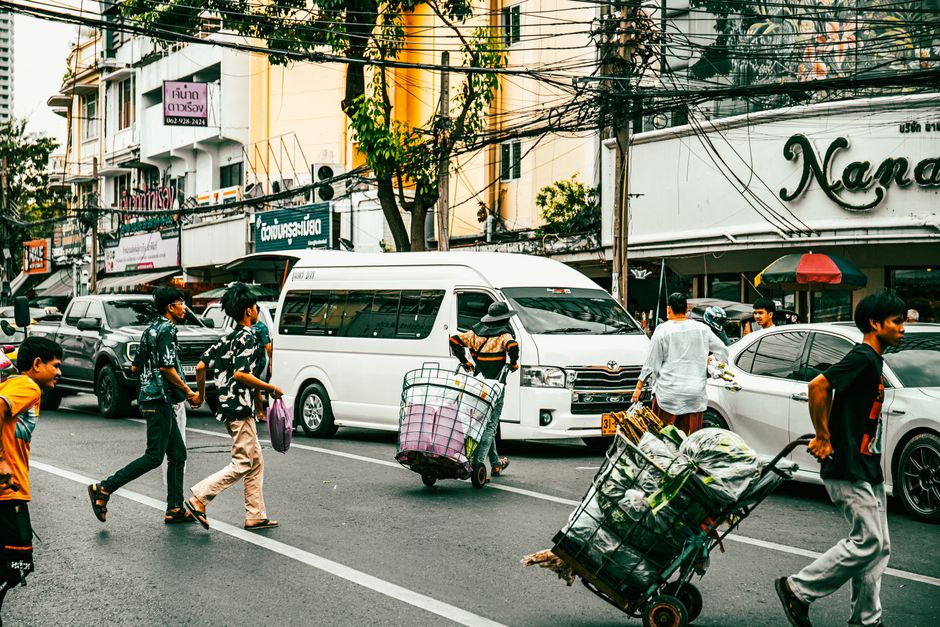
Where you live in Bangkok dictates which co-working space makes sense. Commuting across Sukhumvit Road at 6pm can eat 45 minutes of your evening. Choose wrong and you will stop going to the space entirely by week three.
If you stay near On Nut or Phra Khanong, Launchpad is the obvious pick. At 2,800 baht monthly for a hot desk, it undercuts everything on Sukhumvit proper. The tradeoff: fewer networking events and a more local crowd. If you need to impress clients, this is not the space.
If you stay in Thonglor or Ekkamai, The Hive Thonglor is the default choice for a reason. The space fills with startup founders and remote workers from Europe and Australia. The 3,900 baht monthly hot desk buys you a seat in a room where actual business happens. But the coffee shop downstairs charges 160 baht for a latte, and that adds up.
If you stay in Sathorn or Silom, Glowfish Sathorn at 3,200 baht monthly is the best value. It is quieter than The Hive. Fewer events, more focus time. The building has a 7-Eleven downstairs for cheap food, which matters on long workdays.
Failure Modes: How Long-Term Visitors Waste Money
The most common mistake I see is paying for a monthly membership at a space 40 minutes from your apartment. You tell yourself the commute is fine. It is not fine. By month two, you are working from your condo and paying 4,000 baht for nothing.
Here are the specific failure modes to avoid:
- Buying before you test. Every space on that table offers a free trial day or a heavily discounted first week. Use it. Sit in the actual chair you will occupy for eight hours. Test the wifi speed on a video call at 2pm, not 9am.
- Ignoring air conditioning levels. Some Bangkok co-working spaces run AC at 18°C. You will freeze. Bring a jacket on your trial day and pay attention.
- Forgetting about BTS/MRT access. The Hive Thonglor sits a 10-minute walk from Thonglor BTS. In April heat, that walk feels like 30 minutes. Check the actual walking distance, not the neighborhood name.
- Signing annual contracts for a 3-month stay. Some spaces offer discounts for 6-month or 12-month commitments. Do not take them unless you are certain. Bangkok plans change.
- Overlooking the 24/7 access question. Not every space is open around the clock. JustCo locations typically close at 7pm on weekdays. If you work US hours, you need a space with 24/7 access, like Launchpad or The Hive’s dedicated desk tier.
When Not to Rent a Co-working Space at All
Here is the counterintuitive part: some long-term visitors should skip co-working entirely. If your work is pure deep focus — writing, coding, data analysis — a quiet condo with a good desk setup may beat any shared space. Condo wifi in newer Bangkok buildings frequently hits 300 Mbps down. A decent ergonomic chair costs 3,000 baht at IKEA Bangna. You can build a better workspace than most co-working spaces for the cost of two months of membership.
The co-working premium buys three things: social contact, meeting rooms, and separation between work and home. If you do not need those, do not pay for them. I have met remote workers who spent six months in Bangkok working from their condo and coffee shops, and they were fine. Lonely, but fine.
For everyone else — the people who need client meeting spaces, the people who go stir-crazy alone, the people who network for work — a monthly membership is the right call. Just pick the right neighborhood first.
Q&A: The Questions That Actually Matter
Can I get a Thai visa that allows long-term remote work?
Thailand does not have a dedicated digital nomad visa. The Destination Thailand Visa (DTV), launched in 2026 and still active in 2026, allows remote workers to stay up to 180 days per entry, extendable for another 180 days. It requires proof of at least 500,000 baht in savings or income. Co-working spaces do not sponsor visas. Sort your visa before committing to a three-month membership.
What internet speed should I expect?
Most established co-working spaces in Bangkok run 200–500 Mbps fiber connections. The Hive Thonglor advertises 1 Gbps on its dedicated desk tier. Test this yourself on a trial day. Run a speed test at 2pm when the space is full. Anything under 50 Mbps download is a problem for video calls.
Are there quiet zones for calls?
This varies wildly. Glowfish Sathorn has dedicated phone booths — small, soundproofed rooms you can book for calls. The Hive Thonglor has open call areas that get loud. If you take three video calls daily, verify the phone booth situation before signing. Some spaces charge extra for booth time.
What about parking?
If you drive in Bangkok — and few long-term visitors do — check parking costs. Spaces Chamchuri Square includes parking in its building. The Hive Thonglor does not. Most long-term visitors use BTS or motorbike taxis anyway. Parking rarely matters, but when it does, it adds 100–200 baht daily.
Pick the space closest to your condo, test it on a full workday, and commit monthly — never annually.