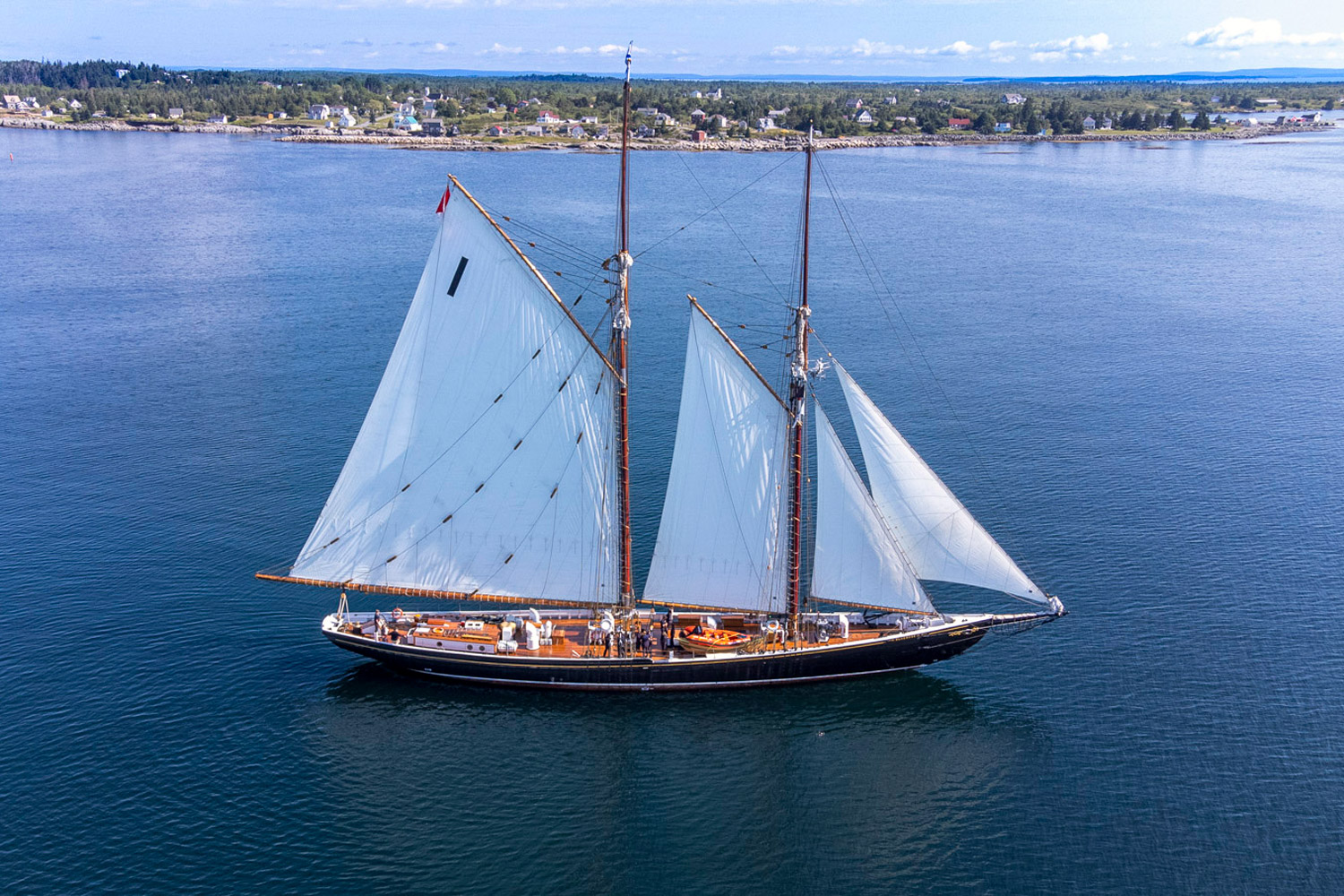
Reach into your pocket and pull out a Canadian dime. The ship embossed on the reverse side sailed out of a town of roughly 2,000 people, went undefeated in official racing competition for 17 years, and was eventually sold off to haul cargo near Haiti, where she sank in January 1946. She never returned to the harbor where she was built.
That harbor is Lunenburg, Nova Scotia. The ship is the Bluenose. Understanding why a small fishing community still defines itself around a vessel it lost nearly 80 years ago tells you something real about what a town actually is — and why some places repay careful attention.
This is not legal advice — consult a licensed attorney for any legal matters related to heritage property designation or vessel classification in Nova Scotia.
The Race That Put a Ship on the Canadian Dime
The International Fishermen’s Trophy was created in 1920 by the Halifax Herald newspaper, largely in response to American schooner racing out of Gloucester, Massachusetts. The founding rule gave the series its credibility: all competing vessels had to be genuine working fishing boats, not purpose-built racers. No yacht-club modifications. No hulls designed solely for speed.
The Bluenose was designed by William Roue, a Halifax naval architect who held no formal degree in the field. She was built at the Smith and Rhuland Shipyard in Lunenburg and launched on March 26, 1921, at a construction cost of approximately $35,000.
The Specifications That Made Her Fast
At 143 feet overall — 112 feet on the waterline — with a 27-foot beam and 15.8-foot draft, the Bluenose displaced 285 tons and carried roughly 14,000 square feet of canvas. That sail area was notably larger than competing American schooners of comparable hull length. Roue made that choice deliberately, according to historical accounts of her design process. More canvas means more speed when the wind cooperates, and more demand on the helmsman when it does not.
Her official racing record, as documented in the Halifax Herald and confirmed by Canadian maritime historians, breaks down as follows:
- 1921 — Won the Fishermen’s Trophy in her first year of competition
- 1922 — Defeated the Elsie (Gloucester) in two straight races
- 1923 — Defeated the Henry Ford in two straight races
- 1925 — Defeated the Haligonian
- 1926 — Defeated the Columbia (Gloucester)
- 1931 — Returned after a six-year gap; defeated the Gertrude L. Thebaud
- 1938 — Final series ever held; defeated the Gertrude L. Thebaud in the deciding race
No official defeats across 17 years of competition. The Royal Canadian Mint put her image on the 10-cent coin in 1937, designed by Emanuel Hahn. That same profile has appeared on every Canadian dime minted since.
Captain Angus Walters: The Man Who Knew the Boat
Walters was not a specialist racing skipper. He was a Lunenburg fisherman who worked the Grand Banks aboard the Bluenose every season, hauling cod with the same crew that raced her. When American competitors suggested victories were due to superior boat design rather than seamanship, Walters reportedly offered to switch vessels mid-series. The Gloucester crews declined.
When the Bluenose was sold in 1942 — wartime economics had gutted the salt-fish trade — Walters attempted a public buyback campaign. He couldn’t raise the funds. The ship was sold to the West Indies Trading Company, converted to cargo work, and struck a reef off Haiti on January 28, 1946. Walters lived until 1968. The ship did not outlive his career.
What the Bluenose Actually Meant to the People Who Built Her
Lunenburg was founded in 1753 as a planned British settlement, but the cod fishery shaped what it became. The Grand Banks — the shallow offshore plateaus southeast of Newfoundland — were among the richest fishing grounds in the world, and Lunenburg’s schooner fleet worked them continuously from the mid-1800s onward.
A working Grand Banks schooner in the 1920s was not a romantic object. Crews of 18 to 22 men. Multiple dories deployed miles from the mother vessel in North Atlantic fog. Men fishing by hand line from open boats while the schooner drifted beyond sight. The mortality rate was significant — maritime historians have generally estimated that Lunenburg lost dozens of fishermen per decade to the Banks during the dory-fishing era. The Bluenose fished. Her racing victories were secondary to the crew’s immediate concern of landing cod and returning home.
What the racing fame gave Lunenburg was visibility that the fish trade could never produce on its own. The Fishermen’s Trophy races were front-page news across Canada from 1921 onward. Photographs of the Bluenose running before the wind appeared in Halifax, Toronto, and Vancouver papers. She appeared in tobacco advertisements, magazine covers, and newsreel footage shown in cinemas from coast to coast. For a town of 2,000 people whose primary industry was invisible to most Canadians, this was a different kind of capital entirely.
How a Racing Champion Became a National Symbol
The salt-fish trade collapsed in the early 1940s, and with it the economic foundation of the Grand Banks fishery as Lunenburg had known it. The fleet contracted sharply. But the Bluenose had already done its work — her image was on the national currency, her name was known from Vancouver to Halifax, and the town had an identity that outlasted the industry that created it.
Heritage scholars have noted that this name recognition almost certainly supported Lunenburg’s case when UNESCO designated its Old Town a World Heritage Site in 1995, recognizing the intact 18th-century British colonial planned townscape. Under Canadian federal heritage law and Nova Scotia’s heritage property regulations, that designation has real legal weight: it governs what can be modified on the waterfront and in the historic district, directly shaping the physical character that visitors encounter today. The Bluenose didn’t just win races. She gave a fishing community a story about itself that outlasted the era that produced her.
Bluenose I vs. Bluenose II: What You’re Actually Visiting
The vessel docked at the Lunenburg waterfront today is the Bluenose II, built in 1963 at the same Smith and Rhuland Shipyard from the same original plans. She underwent a major rebuild from 2009 to 2012 at a cost of CAD $14.6 million, with modern structural materials used where the originals would have failed current safety standards. Maritime heritage institutions in Canada have generally classified her as a replica — a distinction that carries real legal and historical weight.
| Feature | Bluenose I (1921–1946) | Bluenose II (1963–present) |
|---|---|---|
| Built at | Smith and Rhuland, Lunenburg | Smith and Rhuland, Lunenburg |
| Designer | William Roue | Same original Roue plans |
| Length overall | 143 ft | 143 ft |
| Primary purpose | Grand Banks fishing + racing | Provincial ambassador + tourism |
| Major rebuild | — | 2009–2012 (CAD $14.6 million) |
| Current status | Sank off Haiti, Jan. 28, 1946 | Active; home port Lunenburg, NS |
| Public sailing tours | No | Yes — ~CAD $35–50/person, 2-hour sail |
| Official racing record | Undefeated 1921–1938 | Not a racing vessel |
Knowing you’re boarding a 1963 replica doesn’t diminish the experience of sailing on her. But visitors should understand what they’re boarding before they arrive.
How to Plan a Bluenose Visit That Actually Delivers
Lunenburg sits 90 minutes southwest of Halifax by car via Highway 103 and Route 324. The drive is straightforward. What consistently catches visitors off-guard is the Bluenose II’s schedule — she is not always in port, and she travels extensively.
Check the Bluenose II Schedule Before Booking Anything
The Bluenose II operates as Nova Scotia’s provincial sailing ambassador from May through October, making extended stops in Halifax, Pictou, Sydney, and other Maritime ports. Her official schedule is published and regularly updated on the Nova Scotia government’s Bluenose II website (bluenose2.novascotia.ca). She can be absent from Lunenburg for weeks at a stretch. If boarding the ship is your primary reason for the trip, checking the schedule before booking accommodations is not optional — it is the entire planning task. This is the single most commonly skipped step in Bluenose trip planning.
The Fisheries Museum of the Atlantic Is Worth the Trip Alone
The Fisheries Museum of the Atlantic on the Lunenburg waterfront holds the most complete publicly accessible Bluenose collection in existence. As of 2026, adult admission runs approximately CAD $14. The museum holds original Fishermen’s Trophy race hardware, Captain Walters’s personal logs, William Roue’s original design drawings, and documentary footage from the 1930s racing series.
Two historic vessels are permanently moored at the museum’s wharf and boardable as part of admission: the Theresa E. Connor, a 1938 wooden saltbank schooner and one of the last surviving vessels of the type that fished alongside the original Bluenose, and the Cape Sable, a steel-hulled side dragger representing the fishery’s later mechanized era. Walking the Theresa E. Connor’s deck gives a direct physical sense of the scale and working conditions of the Grand Banks fishery. It is unglamorous and specific in a way that exhibit photographs cannot replicate.
Booking Bluenose II Sailing Tours
Two-hour public sailing tours typically run CAD $35–$50 per adult. Book two to four weeks in advance during peak summer season — capacity is limited and tours sell out regularly. The tours are narrated harbor sails, not historical recreations of race conditions. They are worth doing when the ship is in port. If she is not, the Silva — a 1939 Norwegian fishing ketch now based in Lunenburg — offers an alternative tall-ship sailing experience on the same harbor.
The Mistake That Wastes Half Your Lunenburg Trip
Arriving to find the Bluenose II is not docked. Not checking the schedule before leaving home. Driving 90 minutes from Halifax only to find she has been in Pictou for the past two weeks.
The schedule is publicly posted. Verify it before you book the hotel. That is the entire task.
What Visitors Most Often Get Wrong About the Bluenose
Is the Bluenose II the Original Ship?
No. The original Bluenose sank in January 1946. The Bluenose II is a 1963 replica, further rebuilt in 2012 using modern structural materials. Canadian maritime heritage institutions have generally classified her as a replica with distinct historical status from the original. Courts addressing heritage vessel disputes in various jurisdictions have typically found that replicas, however faithful, do not inherit the legal or historical identity of the original — though the specific analysis depends on applicable provincial and federal law.
This is not legal advice — consult a licensed attorney for questions related to heritage vessel classification or Canadian maritime law.
Did the Bluenose Ever Lose an Official Race?
Not in International Fishermen’s Trophy competition. There were informal races and disputed series — including a contested 1923 series where protests were filed by both sides — but the official record, as documented in the Halifax Herald and confirmed by Canadian maritime historians, shows no official defeats across her competitive career from 1921 through 1938.
Can You Visit Where She Was Built?
The Smith and Rhuland Shipyard no longer operates. The waterfront site is now commercial, with historical markers identifying its location. The Fisheries Museum covers the shipyard’s history in its permanent exhibits, and the Theresa E. Connor — still afloat after 88 years — provides the most direct surviving physical connection to the craft tradition that produced the Bluenose.
The question of what happens when that generation of vessels is gone entirely — when the last working saltbank schooner has deteriorated beyond preservation, when the Bluenose II’s own structural life eventually runs out — is one that maritime heritage institutions in Atlantic Canada are actively working through. Towns like Lunenburg are doing something precise and deliberate: holding the memory long enough for the next generation to decide whether the considerable cost of keeping it alive is worth paying. That decision will be made within the next decade or two. The answer is not yet settled.