Serbia has more Orthodox monasteries per square kilometer than any other country in the Balkans — over 1,000 of them, some dating to the 12th century, scattered across mountains, gorges, and river valleys that most Western tourists still haven’t found.
That gap between what exists and who knows about it is the central fact of traveling in Serbia right now.
Belgrade: What the Capital Actually Looks Like
Belgrade is not a pretty city in the conventional sense. There’s no cobblestone old town preserved under glass, no city walls, no bay. What it has instead is something harder to manufacture: genuine energy that hasn’t been packaged for export yet.
The city sits at the confluence of the Sava and Danube rivers. Kalemegdan Fortress — the Ottoman-era citadel at the northern tip of the Stari Grad district — is where those rivers meet visually. Sunset from the fortress walls is one of the better free spectacles in Europe. No entrance fee most days, no queue, just a medieval fortification and two rivers turning orange.
Skadarlija: the Bohemian Quarter
Skadarlija is Belgrade’s answer to Montmartre — a sloping cobblestone street lined with mehane (traditional Serbian taverns) that dates to the 19th century. Restaurants like Tri Šešira (Three Hats) and Dva Jelena (Two Deer) have been operating here since the 1850s. A full meal with house wine costs €15-20 per person. For a European capital city, that’s genuine value, not a cheap trick.
Savamala and the Creative District
Savamala, the riverside neighborhood below Kalemegdan, went from derelict warehouses to the most interesting two square kilometers in the city within a decade. The Museum of Yugoslavia sits nearby. Mikser House hosts art events and weekend markets. KC Grad — a repurposed factory — runs film screenings, live concerts, and pop-up markets year-round.
Belgrade’s nightlife reputation — built around Splavovi, the floating clubs moored on the Sava — is deserved. But Savamala is where the daytime version of that energy lives. Both scenes coexist without trying to impress each other.
Getting Around Belgrade
Trams and buses cost 89 RSD (approximately €0.76) per ride with a BusPlus card. A taxi from Nikola Tesla Airport — 18km from the city center — runs €15-20 at official stands inside the terminal. Unlicensed cabs outside the arrivals hall charge double or more. Use the app Car:Go or Yandex Go for app-based rides in the city. Both work reliably and display the fare upfront.
Novi Sad and the Vojvodina Plains: a Different Serbia
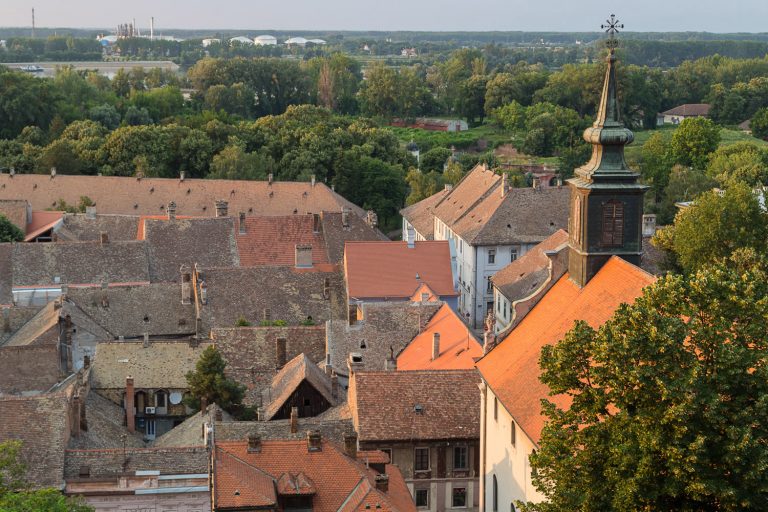
Vojvodina is flat. Relentlessly flat. The northern province looks nothing like the rest of Serbia — it was historically part of the Austro-Hungarian Empire, and the architecture in Novi Sad reflects that clearly. Pastel facades, Baroque churches, and a pedestrianized center that feels closer to Pécs or Timișoara than to Belgrade.
Petrovaradin Fortress — called “the Gibraltar of the Danube” — is the most photogenic single structure in Serbia. It sits on a 40-meter cliff above the Danube. The EXIT Festival, held at the fortress every July, drew over 200,000 visitors in 2026. Outside festival season, Novi Sad is quiet. A university city with a good food scene, no pretension, and river views that cost nothing to stand in front of.
Verdict: two days in Novi Sad is enough when combining it with a Belgrade trip. The train from Belgrade runs approximately 90 minutes and costs around €8. Add a morning in Sremski Karlovci and a loop through Fruška Gora, and you’ve covered the region properly.
Sremski Karlovci: the Wine Town
Fifteen minutes south of Novi Sad by bus, Sremski Karlovci is where Serbian Bermet wine — a fortified local specialty with protected geographical origin status — originated. The Four Lions Fountain in the town square dates to 1799. A tasting at any of the family-run cellars runs €10-15 and typically includes four to six pours. The town takes two hours to see properly. Budget the rest of the day for wine.
Fruška Gora: Monasteries in the Hills
The Fruška Gora range runs parallel to the Danube north of Novi Sad — low, forested hills that don’t look dramatic from a distance. Inside them, 16 Serbian Orthodox monasteries sit within a 50km stretch, some dating to the 15th and 16th centuries. Krušedol Monastery, Novo Hopovo, and Vrdnik are the most visited. None charge entrance fees. Few have crowds. A half-day rental car from Novi Sad opens all of them.
Đavolja Varoš and the Serbian Wilderness
Đavolja Varoš (“Devil’s Town”) is a field of 270 natural stone pillars, some over 15 meters high, carved by erosion across the hills near Kuršumlija in southern Serbia. It looks like concept art for a fantasy novel. It isn’t. There’s no entrance fee. The nearest major city is Niš, roughly 90km north.
Tara National Park, further west near the Bosnian border, has canyon views along the Drina River that rival anything in the Alps — with a fraction of the visitors. Đerdap National Park along the Danube preserves the Iron Gates gorge and remnants of Trajan’s Bridge, a Roman engineering project from 105 AD. Serbia’s wilderness is its most undermarketed asset. If you only see the cities, you’ve missed half the country.
What Serbian Food and Drink Actually Is
Serbian cuisine is not subtle. The portions are large, the flavors are direct, and the dairy is richer than you expect going in.
- Ćevapi — grilled minced meat (pork and beef), served in flatbread called lepinja with kajmak (a clotted cream dairy spread) and raw onion. The best, most Serbians agree, comes from the Leskovac region in the south, not from Belgrade. A portion of 10 costs around €3.
- Karađorđeva šnicla — breaded veal or pork stuffed with kajmak, named after the revolutionary leader Karađorđe. Calorically dense to the point of excess. Worth ordering once.
- Ajvar — roasted red pepper relish, traditionally made every autumn in backyards across the country. The homemade version tastes nothing like the jarred supermarket product sold in Western Europe. If someone offers you theirs, accept it.
- Rakija — Serbian fruit brandy, most commonly plum (šljivovica). Alcohol content ranges from 40% to genuinely unclear. Offered at virtually every household visit; declining is possible but considered rude.
- Serbian wine — the Župa region produces Prokupac, a native red grape most wine drinkers outside the Balkans have never encountered. Rubin Winery’s Prokupac and Rajković Estate’s whites from the Šumadija region are consistent, well-regarded bottles. Expect to pay €5-8 per glass in Belgrade wine bars, €8-15 for a bottle at the winery.
- Burek — filo pastry filled with meat, cheese, or spinach. The standard Serbian breakfast. A full portion at a good pekara (bakery) costs under €2.
The restaurant scene in Belgrade has sharpened considerably. Stara Hercegovina — a 19th-century house in the Zemun district repurposed as a restaurant — does traditional Serbian food with real craft and no tourist padding. But the best meals in Serbia tend to happen in someone’s kitchen. That’s not a romantic observation. It’s just true.
The Real Cost of Traveling Serbia
Serbia uses the Serbian dinar (RSD). As of 2026, €1 ≈ 117 RSD. Serbia is not in the EU, not in the Eurozone, and does not use the euro — though some tourist-facing businesses accept it at unfavorable rates. Exchange at a bank or ATM on arrival.
| Category | Budget Traveler | Mid-Range | Comfort |
|---|---|---|---|
| Accommodation (per night) | €12-18 (hostel dorm) | €40-65 (3-star hotel) | €90-150 (boutique hotel) |
| Food (3 meals/day) | €8-12 | €20-35 | €40-70 |
| Local transport | €2-4 (bus/tram) | €5-10 (mix of bus and apps) | €15-30 (taxis and ride apps) |
| Attractions and entry | €0-5 | €5-15 | €15-30 |
| Estimated daily total | €22-39 | €70-125 | €160-280 |
Serbia is cheaper than Croatia, Slovenia, and Hungary for comparable accommodation quality. That price-to-experience gap is real, and it’s still largely intact — for now.
Visa and Entry
Citizens of the EU, US, UK, Canada, and Australia can enter Serbia visa-free for up to 90 days. Serbia is not in the Schengen Area, so time spent there does not count against your 90-day Schengen allowance. That makes it a logical leg on longer European itineraries.
Getting There
Air Serbia operates direct flights from major European hubs. Belgrade Nikola Tesla Airport (BEG) connects to London Heathrow, Paris CDG, Frankfurt, Vienna, and Amsterdam. Wizz Air adds routes from London Luton, Rome, and several other European cities. One-way fares from London range from £80-160 depending on timing and booking window. No direct transatlantic routes — most passengers from North America connect through Vienna (Austrian Airlines), Istanbul (Turkish Airlines), or Zürich (Swiss).
What Travelers Get Wrong About Serbia
Is Serbia safe to visit?
Safer than the headlines suggest. Petty theft exists in Belgrade city center as in any capital. The violence of the 1990s has no practical bearing on daily life in 2026 — that conflict ended 25 years ago. Locals are consistently described by visitors as hospitable to an almost inconvenient degree. Being offered coffee and food in a stranger’s home during a casual conversation is not unusual. It happens.
Do people speak English?
In Belgrade, Novi Sad, and Niš — widely, especially among anyone under 40. In rural areas, coverage is spottier. Learning five words of Serbian (hvala = thank you, molim = please, dobar dan = good day) creates goodwill that’s disproportionate to the effort. Both Cyrillic and Latin scripts appear on most signage, so navigation isn’t as difficult as it first appears.
What’s the biggest mistake first-time visitors make?
Spending all their time in Belgrade and leaving. Serbia has five national parks. Tara National Park in the west has canyon views along the Drina that most visitors find genuinely surprising. Đerdap along the Danube — home to the Iron Gates gorge — gets fewer visitors than some mid-size city museums. The country opens up with a rental car. Without one, you’re seeing maybe 30% of what’s available.
Is Serbia worth visiting if you’ve already done Croatia?
Yes. Completely different trip. Croatia’s Adriatic coast is manicured, expensive, and in July almost unbearably crowded. Serbia is rawer, cheaper, and less curated. Whether that’s a selling point or a dealbreaker depends entirely on what you’re after — but they’re not competing for the same traveler.
Niš, Subotica, and the Cities Worth Adding to Your Route
Niš is the most underrated city in the Balkans. Most first-time visitors to Serbia skip it entirely. That’s a mistake worth correcting.
Niš is Serbia’s third-largest city and the birthplace of the Roman Emperor Constantine the Great. The Niš Fortress, built by the Ottomans in the 18th century over Roman foundations, is larger than Kalemegdan and almost entirely free of tourists. Skull Tower — constructed by Ottoman forces in 1809 using the skulls of Serbian rebels killed in the Battle of Čegar — contains 952 embedded skulls across 58 niches, partially enclosed in a 19th-century chapel. No equivalent monument exists anywhere in Europe. Entry costs 100 RSD, under €1.
Food in Niš runs 30-40% cheaper than Belgrade. The old bazaar, Čaršija, has been a commercial street since the 14th century. The local grilling tradition — Leskovac-style, featuring skinless sausages and broad flat burgers called pljeskavica — is considered by many Serbians to be the finest in the country. That’s a legitimate claim.
Subotica: the Art Nouveau Outlier
Subotica, in the far north near the Hungarian border, is architecturally unlike anywhere else in Serbia. Its City Hall, built in 1910, is a full Art Nouveau structure — one of the most ornate secular buildings in the entire Balkans. The population is mixed Serbian, Hungarian, and Croatian; Hungarian is widely spoken. It feels like a city from a different country, because geographically it almost was until 1918. Two days here is plenty. One is enough to see the key sites.
A 10-Day Route That Covers the Essential Scenes
- Days 1-3: Belgrade — Kalemegdan, Skadarlija, Savamala, Zemun riverside
- Day 4: Novi Sad day trip plus Sremski Karlovci wine tasting
- Days 5-6: Tara National Park — rent a car from Belgrade (Hertz and Budget both operate from BEG airport)
- Days 7-8: Niš — fortress, Skull Tower, Čaršija, Leskovac grill
- Day 9: Subotica (train north, overnight stay)
- Day 10: Return to Belgrade for departure
Total intercity train and bus transport for this route costs approximately €45-65. The main additional expense is the rental car for Tara, which runs €30-50 per day from Belgrade agencies. Everything else is bus or train, both reliable and cheap.
Serbia in 2026 is still a country where the effort-to-reward ratio tilts sharply in the traveler’s favor. That rarely stays true once the crowds discover a place.